What Would Our Economy Look Like If We Only Ate What We Needed & Home Cooked?

I often joke with people that the US economy is propped up on pain and suffering. Many of the most successful companies are built around products and services that literally rely on poor outcomes. The healthcare system makes more money treating disease than preventing it. Ultra-processed food companies benefit from sugary-food addiction, which leads to obesity and diabetes, over the health and wellness of their customers.
For most of my life, I didn't even notice. I ate pizza, hamburgers, french fries and any number of salty sweet processed foods that were conveniently available to fuel my jet set and stressful career. It wasn't until I found myself in the ICU after suffering a pulmonary embolism that I started asking questions. Don't get me wrong, it wasn't a piece of pizza that caused an emergency. But, it was decades of poor nutrition combined with a relatively sedate lifestyle and an easily undiagnosed allergy to gluten that all conspired to create the perfect storm that almost killed me.
People will tell you that what you eat is a choice and it's up to each of us to decide what is best for us individually. I agree with that sentiment. It's not for me or anyone else to tell others what to do, what to eat and how to spend their money. However, it is interesting to look at what could happen if we all ate right, in the right amounts and fully cut out ultra-processed foods.
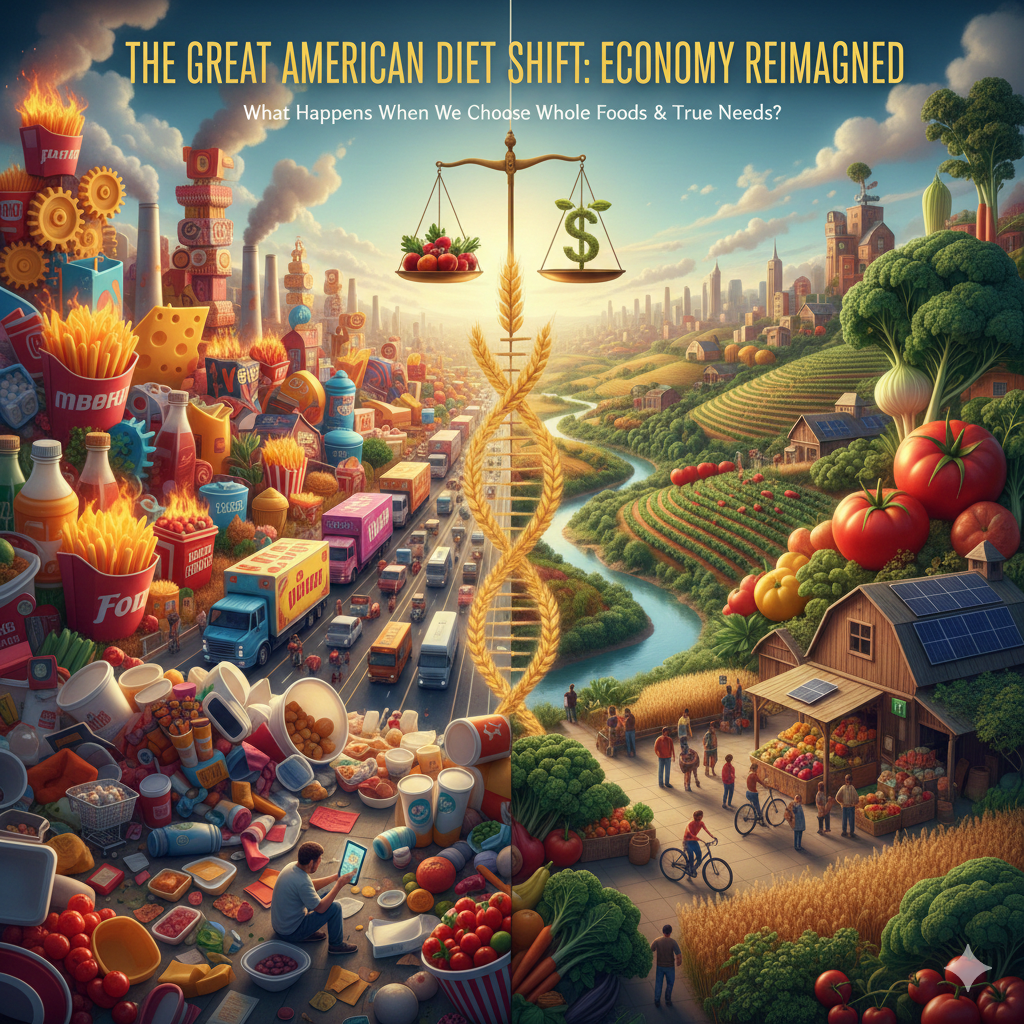
This research is all done by AI (Google Gemini Deep Research to be exact) and it tells a story I did not expect. My assumption when prompting the research was that it would essentially crash the US economy. While that may be true of certain industries like Fast Food, Packaged Goods and Big Pharma, it actually boosts the economy for the average person that just lives in it. Read the full report here or simply take a look at the infographic below to see a summary.
Every day I see posts, articles and video content from major talking heads across the tech industry touting the virtues of AI and how it's going to replace all knowledge worker jobs over the next 2-5 years. No one really talks about what all those workers are going to do now that their jobs can job themselves. If people are no longer needed to sit in a cubicle in front of a screen all day then do they need to live in a major city at all, eating carry out and existing sedately? What if AI led to a mass exodus from major cities and people reclaimed their role as stewards of the land, lived simpler lives, got daily exercise, ate what they grew and provided for their communities? What if?
THE ECONOMIC RENAISSANCE
The Trillion-Dollar Impact of Healthy Eating
What would happen to the US economy if every citizen ate recommended calories from whole, natural foods? A visual analysis of shifting spending, healthcare savings, and productivity booms.
The Consumption Crisis
The average American consumes significantly more calories than recommended, with the majority derived from ultra-processed sources. This "caloric overhead" fuels an entire industry but burdens the healthcare system. The gap between Current Consumption and Scientific Recommendation represents the initial economic friction point.
Calories: Quantity vs. Quality
Comparison of daily intake source and volume.
The Price of Processing
A diet high in processed foods correlates directly with chronic conditions. Currently, diet-related diseases consume a massive portion of the National Health Expenditure (NHE).
75% of healthcare spending goes to treating chronic diseases, most of which are preventable via diet.
Cardiovascular Disease
Costs the economy over $363 Billion annually in healthcare and lost productivity. A whole-food diet lowers risk by ~30%.
Type 2 Diabetes
Direct medical costs exceed $327 Billion. Remission is possible through strict dietary adherence.
Obesity
Associated medical costs are nearly $173 Billion higher than for those at a healthy weight.
The "Health Dividend"
Projected cumulative savings over a decade if the US population adopted a whole-food, calorie-appropriate diet.
Unlocking Workforce Potential
Poor diet doesn't just increase hospital bills; it saps daily energy. "Presenteeism" (working while unwell) and absenteeism cost employers billions. A nutrient-dense diet stabilizes energy levels and immune function.
- ✓ Reduced Sick Days
- ✓ Higher Cognitive Function
- ✓ Lower Insurance Premiums
The Economic Shift
Industry Winners & Losers
A transition to whole foods fundamentally alters the GDP composition.
The Cycle of Vitality
Dietary Improvement
Whole foods, caloric balance, nutrient density.
Health Outcomes
Lower BMI, Reduced Inflammation, Disease Remission.
Economic Surplus
Lower Taxes/Premiums, Higher Disposable Income.
Increased Investment
Funds diverted from disease care to education & infrastructure.